
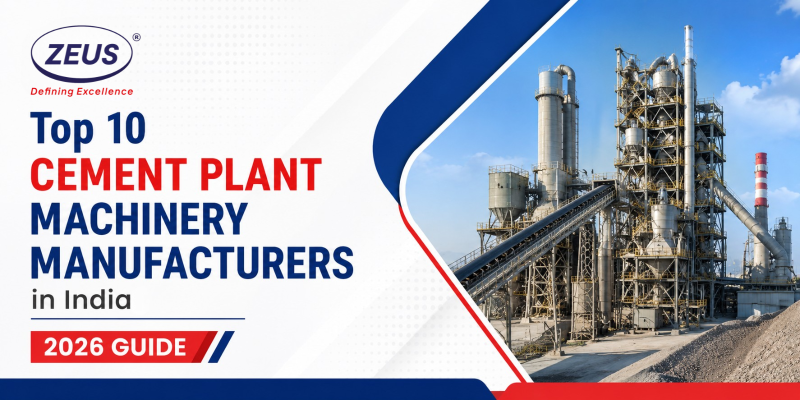
India’s growing cement industry requires reliable machinery to handle raw materials, clinker, cement and other bulk materials efficiently. From crushing and feeding to conveying, screening, storage and dispatch, every stage of a cement plant depends on properly engineered equipment.
For cement manufacturers, choosing the right machinery partner is therefore an important decision. This guide covers the Top 10 cement plant machinery manufacturers in India and explains the key equipment, capabilities and factors that buyers should consider before selecting a supplier.
This guide explains the 10 essential types of cement plant machinery that cement manufacturers should consider when evaluating equipment suppliers in India.
Why Cement Plant Machinery Is Important
A cement plant operates continuously and handles large quantities of heavy and abrasive materials.
Therefore, even a small problem with material handling equipment can affect production and increase maintenance costs.
A properly designed cement plant machinery system can help:
- Maintain continuous material flow
- Improve production efficiency
- Reduce manual handling
- Minimize material loss
- Reduce unexpected downtime
- Improve workplace safety
- Simplify maintenance
- Support future plant expansion
Moreover, selecting equipment according to actual plant requirements can improve overall operating performance.
Top 10 Cement Plant Machinery Equipment to Consider
1. Belt Conveyor
Belt conveyors are among the most widely used material handling systems in cement plants.
They transport bulk materials continuously between different sections of a plant. Depending on the application, they can handle materials over short or long conveying distances.
Common applications include:
- Limestone handling
- Coal handling
- Clinker handling
- Cement transportation
- Stockyard material movement
- Plant transfer systems
When selecting a belt conveyor, manufacturers should consider capacity, belt width, conveyor length, material characteristics, elevation and operating conditions.
2. Bucket Elevator
Bucket elevators provide vertical material transportation where conventional horizontal conveying is not suitable.
They use buckets attached to a belt or chain to lift material from one elevation to another.
Bucket elevators can be useful in cement plants for handling materials such as:
- Cement
- Clinker
- Raw materials
- Powdered materials
- Granular materials
The required bucket size, lifting height, capacity, speed and construction depend on the application.
3. Crusher
Crushers reduce large pieces of raw material into smaller sizes suitable for further processing.
Since cement production involves handling limestone and other raw materials, crushing is an important stage of the overall process.
A suitable crusher helps achieve the required material size while maintaining reliable operation.
When selecting crushing equipment, consider:
- Feed size
- Required output size
- Material hardness
- Moisture
- Capacity
- Operating conditions
4. Vibrating Screen
Vibrating screens separate materials according to particle size.
They are useful when a cement plant needs to classify material or remove unwanted oversized particles from the process.
The performance of a vibrating screen depends on factors such as:
- Screening area
- Material characteristics
- Feed rate
- Required separation
- Screen opening
- Operating conditions
Therefore, proper equipment selection is important for achieving consistent screening performance.
5. Apron Feeder
An apron feeder provides controlled feeding of heavy and abrasive materials.
It is particularly useful for applications where conventional feeders may not provide sufficient durability.
Apron feeders can support continuous material flow from storage or feeding areas to crushers and other processing equipment.
Key considerations include:
- Material size
- Material weight
- Required capacity
- Feed arrangement
- Operating environment
6. Tripper Conveyor
A tripper conveyor distributes bulk material to different discharge points.
This makes it useful for applications where material needs to be distributed across a storage area or stockpile.
Tripper systems can be configured according to the plant layout and required discharge locations.
They can help improve:
- Material distribution
- Storage utilization
- Stockpile management
- Operational flexibility
7. Drag Chain Conveyor
Drag chain conveyors transport bulk materials using chains and flights.
They are suitable for applications where robust and continuous material movement is required.
Depending on the plant design, drag chain conveyors can be used for handling clinker, ash, coal and other bulk materials.
Their enclosed configuration can also help control material spillage and dust in suitable applications.
8. Stacker Conveyor
Stacker conveyors help create organized stockpiles of bulk materials.
In large cement plants, efficient storage and stockpile management can significantly influence material flow and plant operations.
A properly designed stacker system can help:
- Improve storage utilization
- Distribute material efficiently
- Reduce manual handling
- Manage large material volumes
- Support continuous operations
9. Screw Conveyor
Screw conveyors use a rotating screw mechanism to move bulk materials through a controlled path.
They are particularly suitable for handling powders, fine materials and other bulk products.
Applications can include:
- Cement
- Powdered materials
- Fine raw materials
- Additives
- Process materials
The conveyor design should match the material characteristics, capacity, conveying distance and installation requirements.
10. Gates and Diverters
Gates and diverters control the direction and flow of bulk materials within a plant.
They can help route material toward different equipment, storage areas, or processing lines.
Depending on the application, the design may need to account for:
- Material type
- Flow rate
- Temperature
- Wear
- Installation position
- Required actuation
Properly designed flow-control equipment helps maintain efficient material movement throughout the plant.
How to Choose the Right Cement Plant Machinery Manufacturer
Choosing a machinery manufacturer should involve more than comparing equipment prices.
1. Understand Your Capacity
Start by determining the required material handling capacity in TPH.
The equipment should comfortably handle the required operating capacity while considering future production requirements.
2. Analyze Material Characteristics
Consider:
- Bulk density
- Particle size
- Moisture
- Temperature
- Abrasiveness
- Material flow characteristics
These factors directly influence equipment selection.
3. Check Plant Layout
Available space and plant configuration determine conveyor length, elevation, transfer points and equipment positioning.
4. Consider Maintenance
Choose equipment that allows convenient inspection, maintenance and replacement of wear components.
5. Evaluate Customization
Every cement plant has different requirements.
Therefore, customized dimensions, capacities, discharge arrangements and configurations can provide a better solution than a standard design.
6. Consider Long-Term Reliability
Instead of focusing only on the initial purchase price, evaluate equipment life, maintenance requirements, energy consumption, spare parts and downtime.
Why Customized Cement Plant Machinery Matters
No two cement plants have exactly the same operating conditions.
One plant may require long-distance conveying, while another may have limited installation space. Similarly, material properties and required capacities can vary significantly.
Therefore, customized machinery can provide a more suitable solution for specific plant requirements.
A customized system can be developed around:
- Required capacity
- Plant layout
- Material characteristics
- Conveyor length
- Elevation
- Discharge points
- Available installation space
- Future expansion
This approach can help cement manufacturers achieve better material flow and long-term operational efficiency.
What Should Cement Manufacturers Ask Before Buying?
Before finalizing a machinery supplier, ask:
Equipment Questions
- What capacity can the equipment handle?
- What materials can it handle?
- What are the operating limitations?
- What maintenance is required?
Engineering Questions
- Can the equipment be customized?
- Can it fit the existing plant layout?
- What information is required for equipment design?
Project Questions
- Is installation support available?
- Is commissioning support available?
- Are spare parts available?
- What technical support is provided after installation?
These questions can help buyers compare suppliers more effectively.
Why Choose Zeus Engitech Private Limited for Cement Plant Material Handling?
For cement manufacturers looking for reliable material handling equipment, Zeus Engitech Private Limited provides customized engineering solutions for demanding industrial applications.
The equipment portfolio includes:
- Belt Conveyors
- Bucket Elevators
- High Angle Cleated Belt Conveyors
- Tripper Conveyors
- Drag Chain Conveyors
- Vibrating Screens
- Apron Feeders
- Stacker Conveyors
- Gates & Diverters
- Other customized material handling systems
The focus is on designing equipment according to the customer’s material, capacity, plant layout and application requirements.
If you are planning a new cement plant, expanding an existing facility, or upgrading your material handling system, discussing your specific requirements with an experienced engineering team can help you identify the right equipment configuration.
Conclusion
Choosing from the Top 10 cement plant machinery manufacturers in India can help cement producers evaluate equipment capabilities, engineering expertise, customization options, and long-term support before making an investment.
The top 10 cement plant machinery equipment categories covered in this guide include Belt Conveyors, Bucket Elevators, Crushers, Vibrating Screens, Apron Feeders, Tripper Conveyors, Drag Chain Conveyors, Stacker Conveyors, Screw Conveyors and Gates & Diverters.
However, choosing the right equipment is only the first step. Cement manufacturers should also evaluate engineering expertise, customization capability, manufacturing quality, maintenance requirements, project support and long-term reliability.
For customized cement plant material handling requirements, Zeus Engitech Private Limited can help develop equipment solutions based on your specific capacity, material, layout and operational requirements.
Planning a cement plant project or equipment upgrade? Share your requirement with Zeus Engitech Private Limited to discuss a suitable material handling solution.
FAQs
What machinery is commonly used in a cement plant?
Common cement plant machinery includes belt conveyors, bucket elevators, crushers, vibrating screens, apron feeders, tripper conveyors, drag chain conveyors, stacker conveyors, screw conveyors and material flow-control equipment.
How do I select the right cement plant machinery?
Consider your required capacity, material characteristics, plant layout, conveying distance, elevation, operating conditions, maintenance requirements and future expansion plans.
Can cement plant machinery be customized?
Yes. Cement plant machinery can be customized according to capacity, material characteristics, plant layout, conveying distance, elevation and other project requirements.
What is the role of a belt conveyor in a cement plant?
A belt conveyor provides continuous transportation of bulk materials between different sections of a cement plant.
Why are bucket elevators used in cement plants?
Bucket elevators are used when materials need to move vertically between different elevations while maintaining controlled material flow.
What should I check before purchasing cement plant equipment?
Check equipment capacity, construction quality, customization options, maintenance requirements, installation support, spare parts availability and after-sales technical support.
Does Zeus Engitech Private Limited provide customized cement plant machinery?
Yes. Zeus Engitech Private Limited develops customized material handling equipment based on the customer’s material, capacity, plant layout and application requirements.